Call020 4520 0325 Emailinfo@hornchurchminibushire.co.uk Quote within the hour
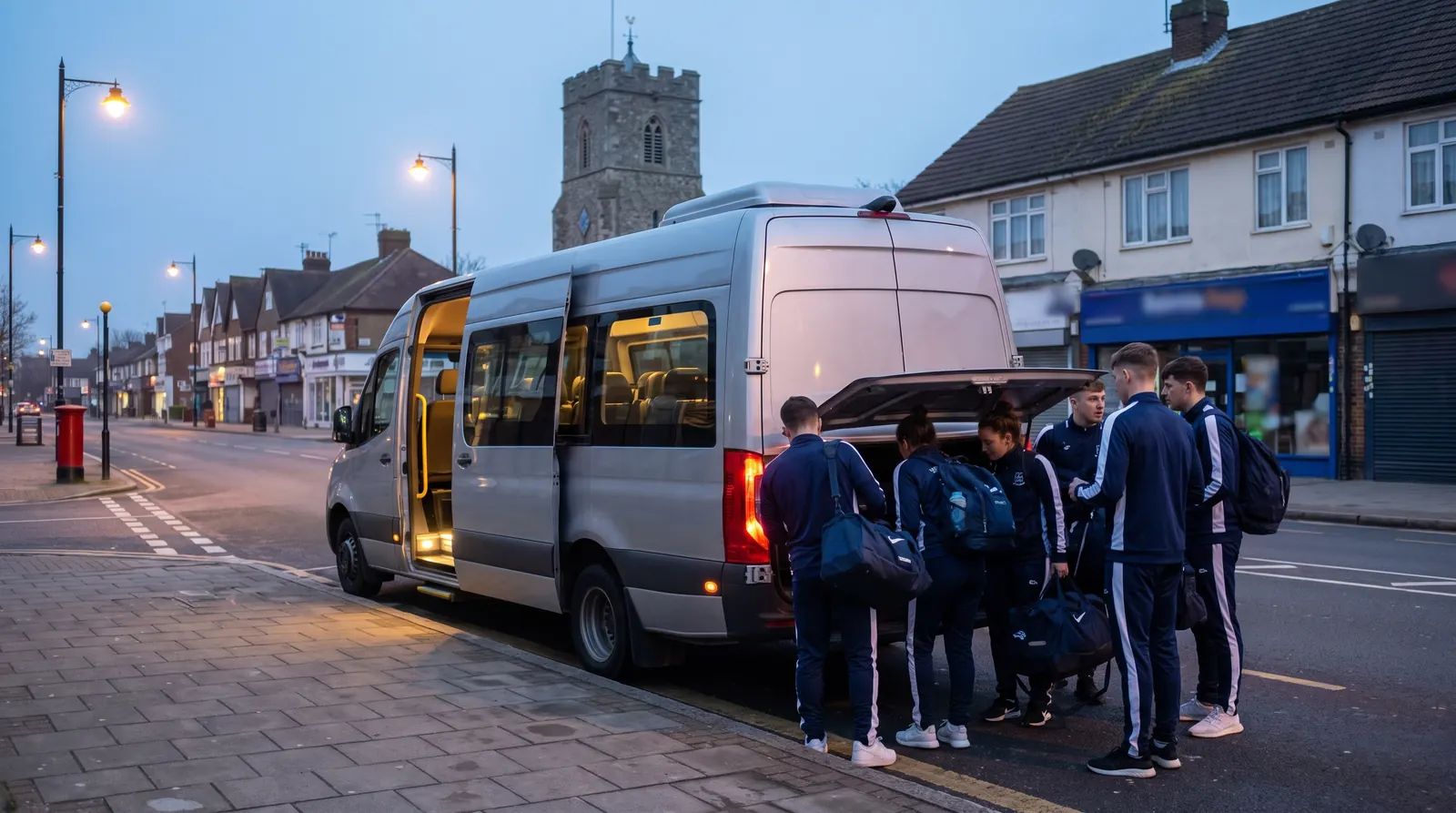
A silver 16-seat minibus at the kerb on Hornchurch High Street before sunrise, a sports team loading kit bags into the luggage bay beside the parish church

Minibus & coach hire with a driver · Hornchurch RM11 & RM12

Minibus hire in Hornchurch, where sixteen seats is usually the right answer

The Queen’s Theatre, the Heritage Centre on Suttons Lane, the country park on the old airfield and the run down to Southend. Sixteen to seventy seats with a driver, quoted within the hour — and we will say when the smaller vehicle is the better one.

  • Not one signed height limit is on a Hornchurch street. The three filed under this town sit in Gidea Park, Cranham and Upminster Bridge. We checked every coordinate rather than repeating the list.
  • LEZ and ULEZ compliant. Havering is inside Greater London, so both zones apply here. Nothing is passed on to you.
  • DBS-checked drivers for school and youth groups, seatbelts throughout, risk assessments on request — and we know which local venues cap a school party at thirty.
Talk to a person 020 4520 0325

Get a price

One screen, no account, no obligation. We come back within the hour.

Your journey and how to reach you
One way or return?
The list

Everywhere we set groups down in Hornchurch, measured from the station

One thing worth knowing before you read a distance: Hornchurch station is not in the middle of Hornchurch. It sits on Station Lane, about a kilometre south of the High Street parade, which is why people arriving by Tube expect a five-minute walk to the shops and get a longer one. Everything below is measured from the station, because that is where most groups start.

  • RAF Hornchurch Heritage Centre 0.97 km · RM12 6RU

    119–121 Suttons Lane. Open to the public at weekends, 11:00–16:00. Monday to Friday the published opening hours say one thing only: “Group & School Bookings”. Adults £6, children 5–15 £3, under-fives free. Themed rooms for Suttons Farm and the First World War, the Battle of Britain, the WAAFs and the USAAF, and a tea room at weekends.

  • The High Street and St Andrew’s 0.96 km · RM11

    The parish church is Grade I listed, first listed on 7 January 1955, and Historic England describes it as thirteenth-century in origin with the fabric largely fourteenth and fifteenth century — nave with aisles, west tower with spire, aisled chancel. The bull’s head on the gable is the thing everyone points at, and the story attached to it runs the wrong way round. More on that below.

  • Harrow Lodge Park 1.03 km · RM12

    Havering calls it the borough’s largest urban park, 130 acres, and it takes the annual borough show. Useful to us because it has three separate vehicle entrances with car parks — off Hornchurch Road, Warren Drive and Upper Rainham Road — so a group can be set down at one end and collected at the other.

  • Queen’s Theatre Hornchurch 1.27 km · RM11 1QT

    A 507-seat producing theatre on Billet Lane — it makes its own work rather than taking tours. It is also the only venue in Hornchurch that publishes something a driver can act on: “There is a coach site at the front of the building with ample room for setting-down and picking-up.” Group rates exist but are not published online; the box office number is 01708 443333.

  • Langtons Gardens 1.29 km · RM11 1AX

    Eleven acres of historic garden with a serpentine lake, an orangery and a bath house, open 8am until dusk and not locked. The Georgian house behind it is Havering’s register office, which makes this wedding-shuttle territory — and the house’s own FAQ is blunt about what that means for vehicles. See the pick-up section.

  • Squadrons Approach, Hornchurch Country Park 1.37 km · RM12 6TS

    The park’s main car park, and the best single fact in Hornchurch. Havering states that “the main car park at Squadrons Approach was an aircraft dispersal bay used to protect Spitfires and their ground crews during the war.” You park on it. Car parks open by 8am and close about dusk; pedestrian access is unrestricted.

  • Hornchurch Stadium 1.43 km · Bridge Avenue

    Capacity 3,500 with 800 seated, a synthetic 400-metre athletics track round the pitch, owned by Havering and opened in 1956. It is also not in Hornchurch — the address is Bridge Avenue, Upminster Bridge. Give a driver “Hornchurch Stadium” and no postcode and you have started an argument.

  • Ingrebourne Valley Nature Discovery Centre 1.46 km · RM12 6DF

    Essex Wildlife Trust, inside the country park, open every day — 10am–5pm from 14 February to 31 October, 10am–4pm from 1 November to 15 February. Café, shop, meeting room. And the line every group organiser in this town should read first: “There is a coach drop-off space. If you are planning to bring a group, please ensure you have pre-booked your visit.” Their published sat-nav postcode is RM12 6TS, not the postal one.

  • Upminster Windmill 1.92 km · Upminster

    A Grade II* smock mill built in 1803 for a local farmer, James Nokes, restored with National Lottery Heritage Fund money and run by the Friends of Upminster Windmill on Havering’s behalf. It opens on scheduled open days only, a handful of weekends a season. Check their calendar before you book a vehicle, not after.

  • Upminster Tithe Barn 3.05 km · RM14 1AU

    A medieval barn with the Museum of Nostalgia inside it. It is on this list so we can tell you not to plan round it yet: their own site says the barn closed for the season while major works were done to the structure and roof, and the next open days are still shown as “2026” with no dates against them.

Hornchurch has no published coach park. Anywhere.

We looked. Havering publishes car parks for Harrow Lodge Park, Langtons Gardens and the country park, and not one of the three mentions coaches. The only published coach provision inside the town is the drop-off at the Essex Wildlife Trust centre and the setting-down space at the front of the Queen’s Theatre. That is not a complaint. It is the reason the sixteen-seater does most of the work here, and the reason we ask where you are going before we name a vehicle.

What people hire us for

Six things Hornchurch groups actually book, and the vehicle each one wants

Not a generic list. Every one of these is a Hornchurch job, and in four of the six the sixteen-seater is the better vehicle — which is an odd thing for a hire company to say out loud and the reason this page exists.

01 · midi or coach

Curtain-up at the Queen’s

A 507-seat producing house on Billet Lane, so a full coach is roughly a tenth of the room and a noticeable block of it. The theatre publishes a coach site at the front of the building with room for setting down and picking up — the only such space in the town — which is why theatre parties here are one of the few local jobs a 49 or 53-seater suits.

02 · minibus or 33

A weekday at the Heritage Centre

The RAF Hornchurch Heritage Centre on Suttons Lane is open to the public at weekends only. Monday to Friday its published hours read “Group & School Bookings” and nothing else, and a school visit is capped at thirty pupils at £5 each, teachers and assistants free. Thirty pupils and four required adults is not a 53-seater’s day out. It is a 33-seat midi, or two minibuses, or two visits.

03 · minibus, usually two

A wedding at Langtons

The Georgian house is Havering’s register office and Langtons Hall seats ninety for a ceremony. Its own FAQ says plainly: “You are unable to park onsite”, and points guests at the Queen’s Theatre pay-and-display and the Sainsbury’s car park in Billet Lane. A shuttle running between a hotel, the gardens and the reception beats ninety people hunting Billet Lane for a space.

04 · coach or decker

Bridge Avenue on a match day

Hornchurch Stadium holds 3,500 with 800 seated, and has a 400-metre synthetic track round the pitch, so it draws away support and athletics meetings alike. Two things to know: it is owned by the council, and despite the name it is in Upminster Bridge, not Hornchurch. Give us the postcode and we will get the right end of Bridge Avenue.

05 · depends on the day

Southend and the Essex coast

Thirty-five kilometres east and the default Hornchurch day out. This is the clearest place the vehicle choice shows up in money: Southend-on-Sea City Council runs a coach park at Eastern Esplanade for up to forty coaches, at £45 on the day or £20 booked in advance. A minibus parks like a car. On a small group that difference is most of a driver’s hour.

06 · minibus

Airport runs at four in the morning

Hornchurch sits on the A127 with the M25 at Junction 29 about a quarter of an hour away, which puts Stansted, Southend and City within easy reach and Gatwick round the bottom of the M25. Sixteen people, sixteen suitcases and one vehicle at the door beats five cars and five airport car parks.

Things worth the journey

What is actually in Hornchurch

Havering is a big borough and Hornchurch is not Romford. It has no market, no shopping centre and no museum of its own beyond the Heritage Centre. What it has instead is a thousand-year-old name, a Georgian garden in the middle of the town, and 257 acres of country park sitting on top of a fighter station.

The name is not what the bull’s head says it is

Everyone in Hornchurch will tell you the town is named after the bull’s head and horns on the east gable of St Andrew’s. It is a good story and it runs backwards. The name is first recorded in 1222, in Latin, as Monasterium Cornutum — the horned monastery — and turns up in English as Hornechurch in 1233 and Hornedechirche in 1291. The accepted reading is “church with horn-like gables”. The priory’s bull’s-head seal and the emblem now on the church both come from the name; they did not produce it. The horns are the answer to a riddle nobody kept the question for.

The church itself is Grade I listed, first listed on 7 January 1955. Historic England’s entry describes thirteenth-century origins with the visible fabric largely fourteenth and fifteenth century, a nave with aisles and south porch, a west tower with a spire, and an aisled chancel. It is at the top of the High Street, roughly a kilometre north of the Tube station, and there is no coach provision at it whatsoever — groups are set down on the High Street and walk the last stretch.

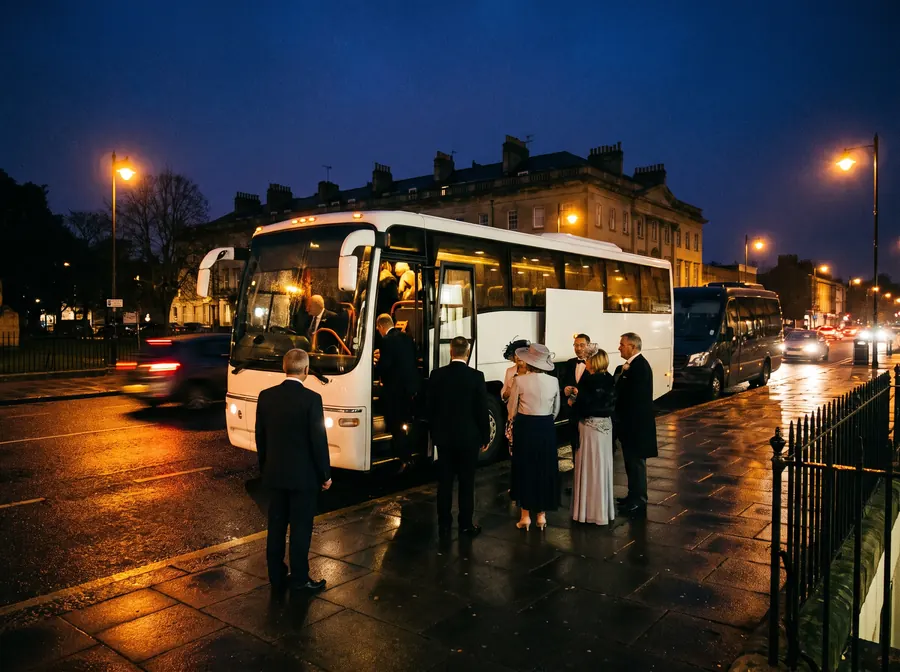
A white touring coach with a minibus parked behind it at night on the road beside Langtons House in Hornchurch, a wedding party in hats and formal dress boarding under orange streetlights on wet tarmac
Langtons, on a wedding night. Two vehicles on one job is normal here — the larger one takes the party from the reception, the minibus collects the handful who are staying somewhere else. Langtons Hall itself has no parking, so everything happens at the kerb on Billet Lane.

Langtons Gardens

About eleven acres now, out of an original ninety, with a serpentine lake, an orangery and a bath house of the late eighteenth century. The remodelling of the grounds is attributed to Humphry Repton. The whole place was given to the town on 1 June 1929 by Varco Williams and his daughter Elizabeth Parkes, on the condition that the house be maintained and the gardens kept open to the public — and they still are, 8am to dusk, not locked. Havering uses the house as its register office. Pay-and-display parking is published for Keswick Avenue and Theatre Road; nothing is published for coaches.

Harrow Lodge Park

The borough’s largest urban park at 130 acres, spread along the River Ravensbourne between Hornchurch and Elm Park, with two lakes, a café that hires out pedal boats, tennis courts, a skate area and a Parkour area. Three vehicle entrances with car parks — Hornchurch Road, Warren Drive and Upper Rainham Road — which for group work is the useful part: drop at one gate, collect at another, and nobody walks back on themselves.

Hornchurch Country Park and the Ingrebourne

257 acres made out of a landfill site from 1980 onward, on the ground of the First World War landing ground at Suttons Farm and the Second World War fighter station that replaced it. London In Bloom made it Country Park of the Year, gold, in 2019. The Ingrebourne Marshes along its eastern edge are a Site of Special Scientific Interest and, in Havering’s words, “the largest fresh water reed bed in the London area” — public access to that part is restricted, but you can see it from the paths. The valley also holds the largest adder hibernaculum in London, which is a sentence worth reading twice before you let a school group off the path.

Essex Wildlife Trust’s Nature Discovery Centre opened inside the park in 2015 and is the only place in Hornchurch with a published coach drop-off. What is left of the airfield is covered further down; it is the reason this page has a long read at the bottom.

The practical bit

Where a vehicle can actually pick up in Hornchurch

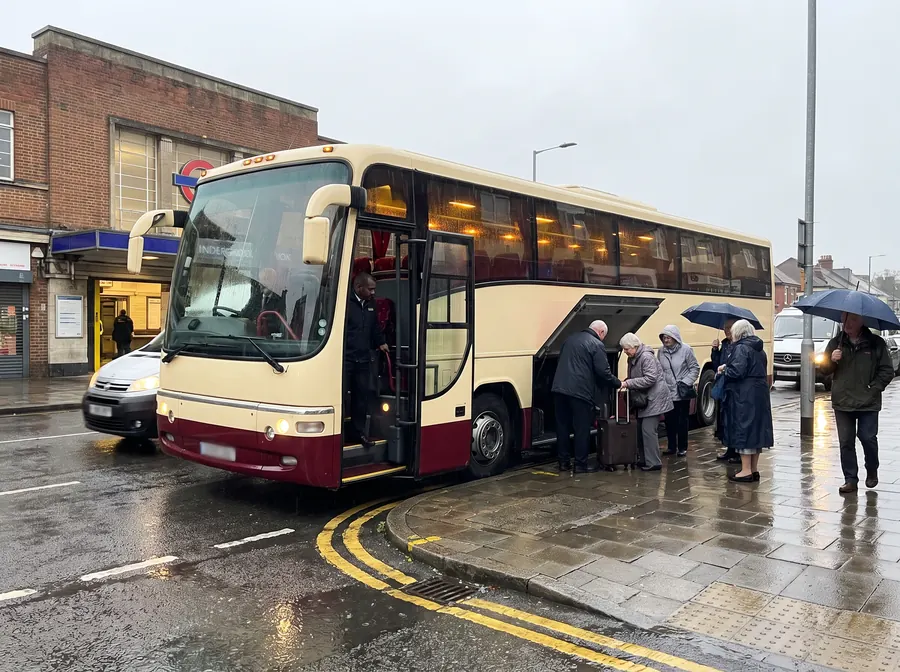
A cream and burgundy touring coach at the kerb in steady rain on the road outside Hornchurch Underground station, an older tour group boarding under umbrellas while the driver loads a case into the luggage bay
Station Lane, outside Hornchurch Underground station. The default pick-up for anyone joining a trip by Tube, and the one place in the town where a full-size vehicle is genuinely straightforward.

Hornchurch is a long thin town strung along Station Lane and the High Street, with the country park hanging off the bottom of it. There is no square, no bus station and no coach park. What there is, in the order we normally use it:

What we work with

  • Hornchurch station, Station Lane (RM12 6LS) — District line, Zone 6, opened by the London, Tilbury and Southend Railway in 1885. A through road with a bus stop and a taxi rank outside, so a vehicle can stand and load without blocking anything. Remember it is about a kilometre south of the High Street, so tell your group “the station”, not “the town centre”.
  • Billet Lane, at the Queen’s Theatre (RM11 1QT) — the theatre publishes a coach site at the front of the building with room for setting down and picking up. It is also the closest usable point for Langtons Gardens, which is a hundred metres up the same road.
  • Squadrons Approach (RM12 6TS) — for the country park and the Nature Discovery Centre. Essex Wildlife Trust publishes a coach drop-off space here and asks groups to pre-book. The Havering car park is about a hundred metres from the centre door.
  • Suttons Lane (RM12 6RU) — for the Heritage Centre. Their own words are “limited but free parking”, and their group booking form asks you to state your vehicle parking requirements, which tells you they would rather know than be surprised. Half a mile from the station.
  • Harrow Lodge Park — three road entrances with car parks, off Hornchurch Road, Warren Drive and Upper Rainham Road.

Two things that catch people out

The country park car parks are locked at dusk. Havering opens them by 8am and closes them at about dusk. Pedestrian access is unrestricted, so a group can still walk out — but an evening collection has to be arranged on the road outside, not inside the park. On a winter school trip that is a four o’clock problem, not a six o’clock one.

Langtons has no parking at all. The venue’s own FAQ says “You are unable to park onsite” and sends guests to the Queen’s Theatre pay-and-display and the Sainsbury’s car park in Billet Lane. For a wedding that means the vehicle sets down at the kerb, leaves, and comes back at an agreed time. It is worth agreeing that time before the day rather than on it.

Where we do not pretend

The top of the High Street, by St Andrew’s, has no coach provision whatsoever. Neither does the stretch of shops in between. If the group is going to the church, we set down at the nearest sensible kerb and everyone walks the last bit — and we would rather say that here than have a driver work it out in front of forty people.

Tell us where the group starts and where it ends and we will name the pick-up point in the quote, with the postcode to give the driver.

Minibus versus coach

Three height limits are filed under Hornchurch. None of them is in Hornchurch.

Most low-bridge lists score every road against a single “coach” height and get it wrong twice over. There is no such thing as one coach height — we run three. A 16-seat minibus needs about 2.8 m. A 49 to 53 seat touring coach needs 3.9 m at the outside: Mercedes-Benz publishes the Tourismo, the commonest 49–53 seater on British roads, at 3.68 m including its roof air conditioning, and a 53-seat MAN Lion’s Coach is 3.87 m. Only the 70-seat double-decker needs 4.4 m, and 4.4 is the number those lists quietly apply to everything.

The second error is geographic. The open height data collected for this town returns three signed limits, and we checked where each one physically is before writing about it. Not one of them is on a Hornchurch street.

Signed height limits filed under Hornchurch, in metres and imperial, with the place each road is actually in and the effect on a 16-seat minibus, a 49 to 53 seat coach and a 70-seat double-decker
Road Where it really is Limit Imperial Minibus
2.8 m
Coach
3.9 m
Decker
4.4 m
Balgores Square Gidea Park, RM2 6AU
3.3 km NNW of the station
1.67 m5′5″ NoNoNo
St Mary’s Lane Cranham, RM14 3JB
3.3 km east of the station
4.10 m13′5″ Fits20 cmNo
Upminster Road Upminster Bridge, RM11 3XL
1.4 km ENE of the station
4.60 m15′1″ FitsFitsFits

Read down the table and the honest summary is short. The only limit that stops anything we run is Balgores Square, and that is in Gidea Park, three and a bit kilometres away on the far side of Romford — a residential square where 1.67 metres stops a transit van, a car with a roof box and very nearly a determined pedestrian. St Mary’s Lane, in Cranham, is a double-decker problem and nothing else: a 53-seater goes under it with about twenty centimetres in hand and a minibus with more than a metre. Upminster Road at Upminster Bridge is the closest of the three to Hornchurch, and it clears all three vehicles.

Twenty centimetres is not much, which is why St Mary’s Lane is marked as a warning rather than a pass. A coach is loaded differently on the way home than on the way out, and a driver trusts the sign over any list, this one included.

So the answer for Hornchurch is not “here are our low bridges”. It is that Hornchurch does not have any, and the constraint on this town is parking and access rather than headroom. That is a more useful thing to know before you book, and it is the opposite of what a list copied straight out of the data would have told you.

Road heights from OpenStreetMap contributors, ODbL. Each road’s location was checked by reverse-geocoding its recorded coordinates rather than trusting the file’s town label, and the distances are measured from the Hornchurch station coordinate. Vehicle heights are the manufacturers’ published figures — Mercedes-Benz Tourismo 3.68 m including roof air conditioning, MAN Lion’s Coach 3.87 m — with 3.9 m taken as the worst case for a high-deck single-decker. Every verdict here was recomputed from the measured limit, not inherited from a single “coach” column. Signed limits change; the sign wins.

Before you compare quotes

Hornchurch is inside both the LEZ and the ULEZ, and which one you meet depends on the vehicle

Havering is a London borough, so both of Transport for London’s emission zones cover Hornchurch in full. They are different schemes over the same ground, and they sort vehicles by weight, not by seats:

  • A minibus at or under 5 tonnes falls under the Ultra Low Emission Zone. If it does not meet the standard that is £12.50 a day, charged 24 hours a day, every day except Christmas Day, across every London borough. The M25 itself is outside the zone.
  • Anything over 5 tonnes — a bus, a larger minibus or a coach — falls under the Low Emission Zone instead, and the standard is Euro VI. Non-compliance is £100 a day for a vehicle that at least meets Euro IV for particulates, and £300 a day for one that does not. The LEZ runs 24 hours a day, every day of the year, with no Christmas exemption.

Our vehicles meet the standards, so there is nothing to pass on to you and nothing to argue about afterwards. It is still worth asking whoever else is quoting. Hornchurch sits close enough to the Essex boundary that operators running in from Brentwood, Basildon or Grays quote here regularly, and an older coach coming the other way is carrying a daily charge somebody has to pay. A quote that does not mention it is not necessarily cheaper — it is sometimes just quieter.

Charges, standards and boundaries are set by Transport for London and change. Figures above were read from TfL’s own pages in August 2026; we confirm the position for the actual vehicle when we quote.

Their words, not ours

Four places where the vehicle you arrive in changes what you pay

This site sells minibus hire, so the question “do we actually need the coach?” comes up on most calls. The clearest way to answer it is to show you four places that publish different rules for a minibus and a coach. Their wording, with the date we checked it.

Battle of Britain Memorial

85 km · Capel-le-Ferne, Kent

“Taxis/minibuses: Taxis and minibuses are classed as cars and are therefore subject to the standard parking charges.”battleofbritainmemorial.org · checked 29 Aug 2026
“Pre-booked coaches bringing visitors to The Wing benefit from free parking. Coaches that are not pre-booked need to pay for parking.”same page, same date

The obvious pairing with a Hornchurch airfield trip, and the one place where the coach is cheaper than the minibus — but only if it is booked ahead.

RAF Museum Midlands, Cosford

211 km · Shropshire

“Parking charges per vehicle (including Blue Badge holders): Cars up to 7 hours £7.50 per vehicle. Motorcycles all day £7.50 per vehicle. Coaches all day FREE.”rafmuseum.org.uk · checked 29 Aug 2026

A long day from Hornchurch, and again the coach parks for nothing while smaller vehicles pay. Sat-nav WV7 3EU rather than the postal TF11 8UP, which their own site is careful to say.

Southend-on-Sea seafront

35 km · Essex

“The coach park within Eastern Esplanade Car Park (formerly the Gas Works) on the seafront (SS1 2AQ) can accommodate up to 40 coaches… Same day parking costs £45… Paying in advance is at the discounted cost of £20.”southend.gov.uk · checked 29 Aug 2026

The nearest seaside day out, and the sharpest illustration of the point: on a group of twelve the coach park alone can cost more than the difference in vehicle. Southend also publishes perks for coach drivers, including free entry to the pier on production of company ID.

IWM Duxford

60 km · Cambridgeshire

“There is free car and lockable motorcycle parking for visitors to IWM Duxford, with the exception of air shows where this must be purchased separately.”iwm.org.uk, under the heading “By car, motorcycle or coach” · checked 29 Aug 2026

Note what that sentence does and does not say. It sits under a heading that includes coaches but names only cars and motorcycles, and air-show days are explicitly different. IWM runs a separate group-visits route, so we confirm the arrangement for the actual date rather than assume it.

We do not have arrangements with any of these places

Nobody selling coach hire does. What we have is the habit of reading what a venue publishes, quoting it back to you with the date, and ringing them when the wording is ambiguous. If a page ever tells you an operator holds a private agreement with a museum, that is worth a second look.

Also popular from Hornchurch

Chessington World of Adventures43 km · Surrey
Colchester Zoo54 km · Essex
Audley End House & Gardens57 km · Essex
Whipsnade Zoo62 km · Bedfordshire
Canterbury67 km · Kent
Clacton-on-Sea70 km · Essex
Brighton85 km · East Sussex
The Thursford Collection152 km · Norfolk

Distances are straight-line from Hornchurch station, so the road journey is longer. Ask us for a run time rather than working from these.

The fleet

Sizes we run out of Hornchurch, smallest first

Three of these are relevant to the height table above, which is why they are labelled with their heights as well as their seats.

16
Minibus
2.8 m
24
Midi coach
33
Midi coach
49
Full coach
3.9 m
53
Full coach
3.9 m
70
Double-decker
4.4 m

Every job comes with a professional driver. Executive seating, wheelchair-accessible vehicles and school-spec vehicles are all available. On a Hornchurch job the honest advice is often to go one size down: the town has no coach park, the country park locks its car parks at dusk, and the Heritage Centre caps a school visit at thirty. Tell us the group and the destination and we will say which vehicle the day actually wants.

Get a price 020 4520 0325
Suttons Lane · eight hundred years of one field

Our registered address is on a fighter station, and the country park car park is a Spitfire pen

Airfield Way is not a developer’s flourish. The industrial estate we are registered at sits on RAF Hornchurch, and the land it stands on has been called Suttons since Henry II gave it away in the twelfth century.

A black executive touring coach at the kerb in low golden late-afternoon sunlight on the road beside the former RAF Hornchurch airfield, open flat grassland behind, a corporate group with laptop bags and lanyards boarding
The southern edge of Hornchurch Country Park in late afternoon. The flat ground behind is the airfield; the housing on the far side is built over the hangars.

Around 1158, Henry II gave a piece of land at Havering to a hospice a very long way away: the house of St Nicholas and St Bernard at Montjoux, in the Valais, in what is now Switzerland. By 1163 he had given them the church as well. The land was recorded as Suttons, in south Hornchurch, and the gift founded Hornchurch Priory beside the parish church. The town’s name is first written down in 1222, in Latin, as Monasterium Cornutum — the horned monastery.

Suttons stayed a farm for the next seven hundred and fifty years. Then, on 3 October 1915, the Royal Flying Corps put a landing ground on it to defend London from German airships. Two BE2c aircraft, a field, and a name taken straight off the farm gate: Sutton’s Farm.

The night the airship came down

Just under a year later, on 2 September 1916, Lieutenant William Leefe Robinson took off from that field into a raid of sixteen airships and shot one down, using a new mixture of Brock and Pomeroy incendiary ammunition. He was given the Victoria Cross and became, briefly, the most famous man in England.

The detail nearly everyone gets wrong is what he actually shot down. It was not a Zeppelin. It was Schütte-Lanz SL11, a rival design with a laminated wooden frame rather than an aluminium one — which is a pedantic distinction until you remember it is the reason the thing burned the way it did, visibly, for miles, in front of a city that had been raided from the air with impunity. Two more Sutton’s Farm pilots, Frederick Sowrey and Wulstan Tempest, took DSOs for destroying airships in the months that followed.

1915
Landing ground opens at Sutton’s Farm
1916
Leefe Robinson’s VC
1928
Reopens, renamed RAF Hornchurch
1962
Station closes, 1 July
257
Acres of country park, from 1980

Eleven Group

The field closed at the end of 1919 and was handed back. Then the Air Ministry bought it again, built a proper station on it over four years, and reopened it in April 1928 as RAF Sutton’s Farm — renaming it RAF Hornchurch two months later. The first unit in was No. 111 Squadron, under a squadron leader called Keith Park, who was also the station’s first commanding officer. Twelve years later Park was running 11 Group, and Hornchurch was one of his sector airfields.

What that meant in 1940 was Spitfires, constantly, and being a target: the station was raided on no fewer than twenty occasions. Richard Hillary arrived on 27 August 1940 and was shot down on 3 September. On 27 June 1940 George VI stood on what is now Tangmere Crescent and pinned decorations on Allen, Tuck, Deere, Malan and Leathart.

And on 24 March 1943, an American volunteer flying with No. 64 Squadron, Flying Officer Raimund “Smudge” Sanders Draper, lost his engine just after take-off with Suttons School full of children in front of him. He stayed with the aircraft and put it into the playing field. The school was renamed Sanders Draper in 1973 and still carries his name.

What is actually left, and what is not

The station closed on 1 July 1962. Ford used it to store Cortinas. Then the gravel companies came, then the refuse, and from 1980 the whole thing was landscaped into Hornchurch Country Park. The hangars and technical site went in the 1960s and are a housing estate now, with the street names doing the remembering — Bouchier Walk, Kirton Close, Tempest Way, Robinson Close, Tuck Road, Bader Way, Malan Square. The Officers’ Mess is a doctors’ surgery in Astra Close, and it, the officers’ quarters at Astra Court and the warrant officers’ houses in Wood Lane are all inside the RAF Hornchurch Conservation Area.

Out in the park, more survives than you would expect: pillboxes, command bunkers, gun positions and the largest number of surviving Tett turrets anywhere in England — one-man concrete pits with a rotating top, sunk into the ground along the eastern edge. And the single best detail is one you can drive onto. Havering states it flatly on its own park page: “The main car park at Squadrons Approach was an aircraft dispersal bay used to protect Spitfires and their ground crews during the war.”

One thing is gone, and it is worth saying because the internet keeps it alive. There was a large concrete dome next to the Good Intent on Southend Road, a planetarium-like thing used to train air gunners. It was demolished. The pub is still there. The dome is not, and no amount of enthusiasm brings it back — so if that is what your group is coming for, come for the Tett turrets and the Heritage Centre instead.

The Heritage Centre that keeps all of this is at 119–121 Suttons Lane — the same Suttons that Henry II gave away in 1158, the same Suttons the landing ground was named after. It opened in 2021, it is run by a charity, and Monday to Friday it opens for group bookings only. Which is the whole argument of this page in one address: in Hornchurch, the interesting places are small, and the vehicle should be too.